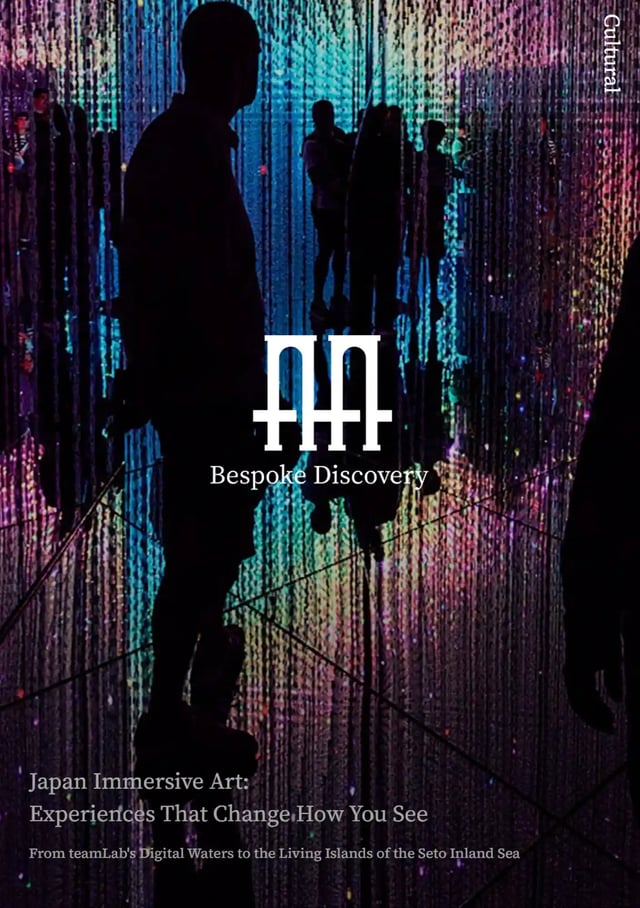
Japan Immersive Art: Experiences That Change How You See

Japan has built one of the world's most concentrated landscapes for immersive art — digital light that responds to your footsteps, islands that are open-air museums, gardens that reorder your thoughts. From teamLab's barefoot waters in Tokyo to the Seto Inland Sea's art islands and Kyoto's Zen gardens: for travelers who seek depth, not sights.
Japan Immersive Art:  Experiences That Change How You See

Experiences You’ll Get from This Guide

At teamLab Planets, barefoot in water, koi dissolve into blossoms. At teamLab Borderless, 75 works migrate between rooms with no map. On Naoshima, a subterranean museum stages Monet in shifting natural light. In Kyoto, fifteen stones have sparked five centuries of debate. A guide to all of it — with practical intelligence and the conviction that some journeys change how you see.

Japan Immersive Art_01

Where the Floor Becomes the Art

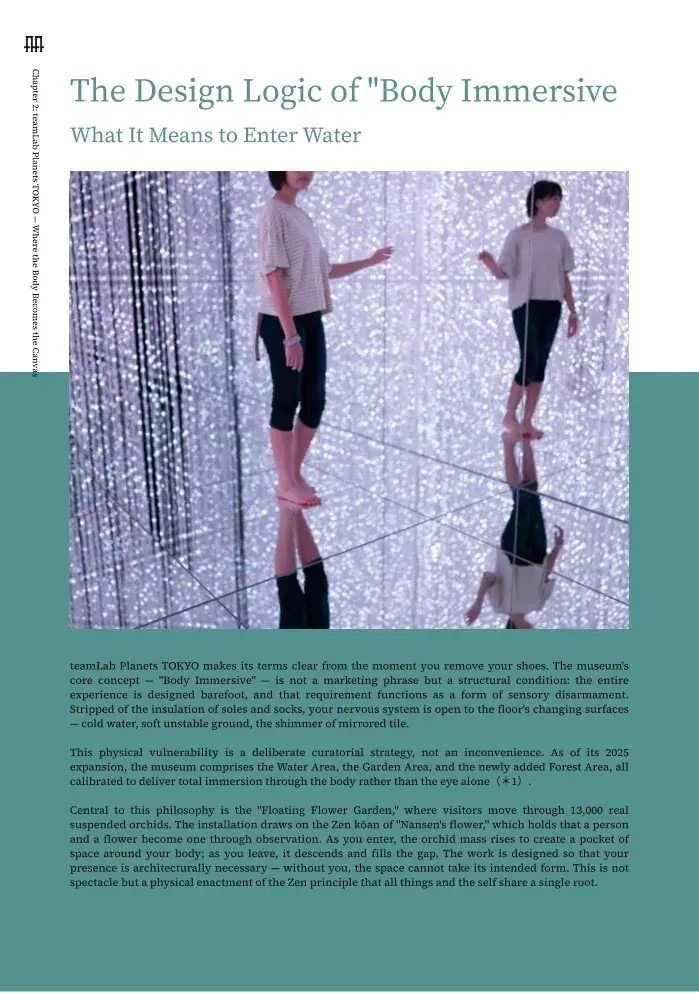
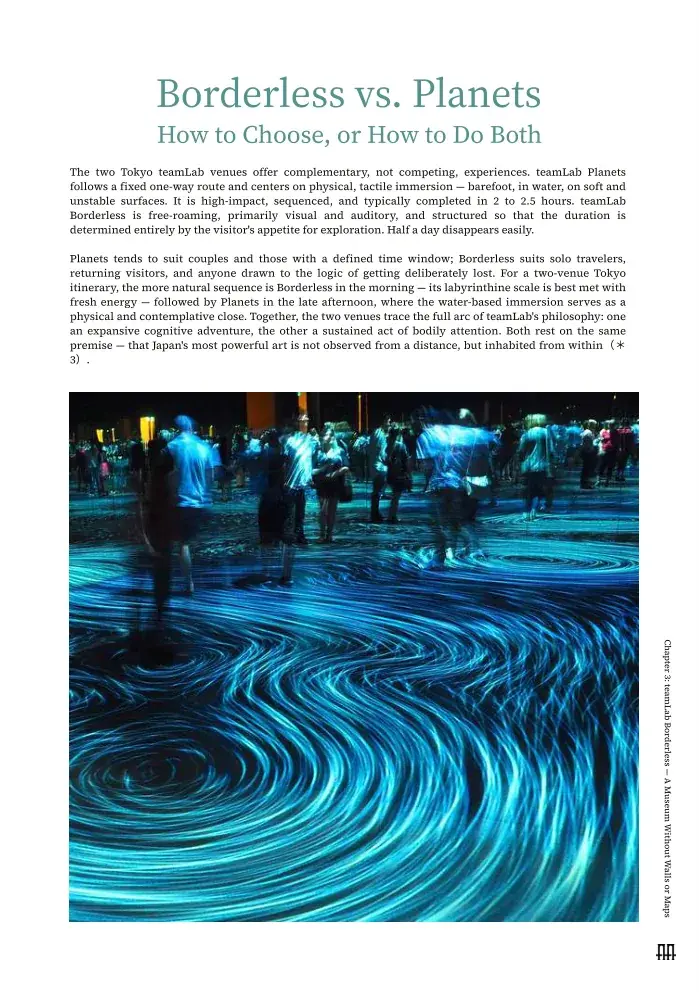
Streams of light flood the floor and shift with every step. The art is not on the wall — it is the space. No frame, no distance, no separation between you and the work.

Japan Immersive Art_02

The Threshold Between Worlds

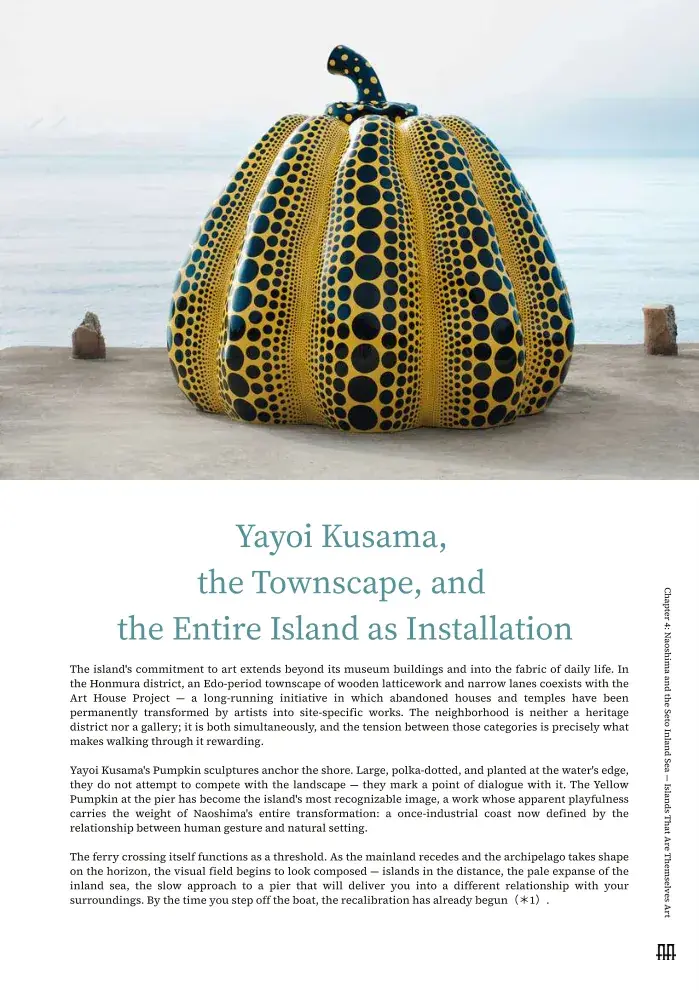
Dusk over the Seto Inland Sea. Islands dissolve into silhouette and the horizon composes like a painting. The ferry begins here — and so does the recalibration of the senses.

Japan Immersive Art_03

Five Centuries of Interpretation

Stone and raked gravel — nothing more, nothing less. In Kyoto's dry landscape gardens, stillness is the medium. The longer you stay, the more the garden begins to look back.

Trusted Information

text text text text text text text text text text text text text text text text text text text text text text text text text text text text text text text text text text text text text text text text text.
tea ceremony master
Taro Yamada
Taro Yamad is an acclaimed Master of the Urasenke Tea Ceremony. He teaches the profound art of Chanoyu in Kyoto and shares the spirit of wabi-sabi globally through demonstrations and lectures.
tea ceremony master
Taro Yamada
Taro Yamad is an acclaimed Master of the Urasenke Tea Ceremony. He teaches the profound art of Chanoyu in Kyoto and shares the spirit of wabi-sabi globally through demonstrations and lectures.
tea ceremony master
Taro Yamada
Taro Yamad is an acclaimed Master of the Urasenke Tea Ceremony. He teaches the profound art of Chanoyu in Kyoto and shares the spirit of wabi-sabi globally through demonstrations and lectures.

Testimonials

Discover what readers from around the world are saying about our guides. Each comment reflects a unique journey into the heart of Japanese culture — from refined traditions and craftsmanship to the quiet beauty found in everyday rituals.

I came to this guide expecting practical information and left with something closer to a shift in perspective. The sections on karesansui gardens and the philosophy of ma articulated something I had felt in Japan but never quite found the language for — that stillness is not absence but presence of a different kind. Understanding wabi-sabi not as an aesthetic trend but as a genuine worldview changed how I read the teamLab chapters too. These are not separate Japans; they are the same sensibility expressed through different centuries. That coherence is what makes this guide quietly remarkable.

Amanda Tan (Australia)

Few travel guides acknowledge what this one does so clearly: that the Japanese approach to hospitality is not a service model but a moral framework. The concept of omotenashi—anticipating need before it is expressed—reframes the entire guest-host relationship in ways that Western hospitality has yet to absorb. Reading about the geometry of seclusion, the engineered silence, the invisible circulation design, I recognized a culture that has thought more carefully about shared space than almost any other. This guide didn't make me want a luxury trip. It made me want to reconsider how I inhabit every space I enter.

Robert Ward (USA)

I came to this guide expecting practical advice. I left it with something closer to a shift in perspective. The section on totonou—that state of being perfectly tuned—resonated beyond the onsen context. It named something I had sensed in Japanese aesthetics but never found words for: the idea that luxury is not addition but subtraction, that the finest hospitality is the kind that disappears. The chapters on silence as design and the spiritual geography of shrine paths made clear that what Japan offers the anniversary traveler is not an experience, but a practice. One you carry long after you leave.


Amanda Tan (Australia)

Sneak Peek Inside the Guide

You can read the first few pages as a preview.
To read the full version, please register using the form.
Scroll
Preview
Scroll
Preview