Few travel guides acknowledge what this one does so clearly: that the Japanese approach to hospitality is not a service model but a moral framework. The concept of omotenashi—anticipating need before it is expressed—reframes the entire guest-host relationship in ways that Western hospitality has yet to absorb. Reading about the geometry of seclusion, the engineered silence, the invisible circulation design, I recognized a culture that has thought more carefully about shared space than almost any other. This guide didn't make me want a luxury trip. It made me want to reconsider how I inhabit every space I enter.
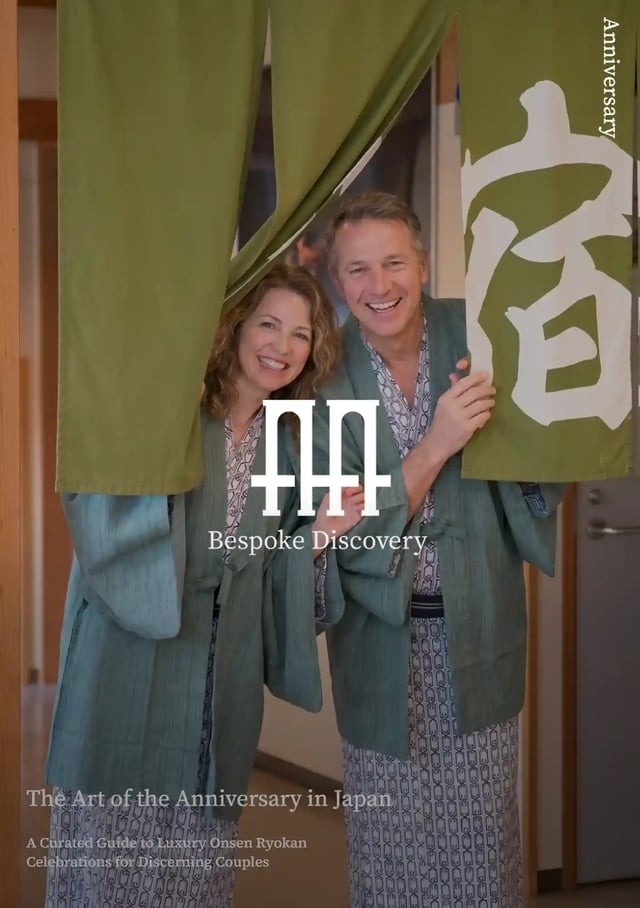
The Art of the Anniversary in Japan
Experiences You’ll Get from This Guide
For the couple who travels well, Japan's luxury onsen ryokan offers what global hospitality rarely can: an anniversary defined by depth rather than amenities. Legally protected mineral waters, omotenashi, and seasonal kaiseki converge in a world outside ordinary time—where celebration becomes permanent.
Where the Earth Breathes
Japan's onsen carry a character no hotel can replicate—color, steam, and stillness. Each spring tells a geological story that becomes part of your anniversary.
The Private World of Two
Japan's private bath creates a world with no audience, no clock. Mineral warmth and the quiet pleasure of being together—in that moment, they are inseparable.
The Season on a Lacquer Tray
Kaiseki arrives not as a meal but as an argument—each small dish a seasonal choice, each vessel a considered act of beauty. At a ryokan, dinner is the most refined part of the celebration.
Trusted Information
Testimonials
Discover what readers from around the world are saying about our guides. Each comment reflects a unique journey into the heart of Japanese culture — from refined traditions and craftsmanship to the quiet beauty found in everyday rituals.
What this guide understood—and articulated beautifully—is that kaiseki is not cuisine; it is cultural memory served on lacquer. The section on chisan-chisho and seasonal sourcing reminded me that Japanese culinary tradition has always treated sustainability not as a trend but as an ethical foundation. I was equally moved by the discussion of craft: the yunohana mineral deposits, the hinoki tub, the nakai's invisible choreography. These are not amenities. They are a living archive of skills passed across generations. This guide gave me the vocabulary to appreciate what I had previously only admired.
I came to this guide expecting practical advice. I left it with something closer to a shift in perspective. The section on totonou—that state of being perfectly tuned—resonated beyond the onsen context. It named something I had sensed in Japanese aesthetics but never found words for: the idea that luxury is not addition but subtraction, that the finest hospitality is the kind that disappears. The chapters on silence as design and the spiritual geography of shrine paths made clear that what Japan offers the anniversary traveler is not an experience, but a practice. One you carry long after you leave.
Sneak Peek Inside the Guide
To read the full version, please register using the form.